
Few cars have captured the essence of racing DNA like the Maserati MC12. Built not just to turn heads but to dominate the track, this extraordinary machine marked Maserati’s powerful return to the world of motorsport after nearly four decades. Introduced in 2004, the MC12 was a limited-run supercar developed to homologate Maserati’s GT1 race car, and it quickly became one of the most exclusive and sought-after vehicles of its time.
With only 50 road-legal units ever made, the MC12 isn’t just rare, it’s a statement of engineering ambition. Sharing much of its core architecture with the Ferrari Enzo but wrapped in a more dramatic body designed for maximum aerodynamic efficiency, the MC12 stood as Maserati’s symbol of speed, precision, and Italian artistry.
In this article, we’ll explore how this extraordinary car came to life, what made it such a technical marvel, and why its legacy still influences Maserati’s modern lineup today. From its deep racing roots to its million-dollar collector status, the Maserati MC12 represents the perfect blend of motorsport purpose and timeless luxury.
Table of Contents
Origins and Purpose of the Maserati MC12
The Maserati MC12 was born from ambition, regulation, and a desire to reclaim Maserati’s racing heritage. After decades away from the racetrack, Maserati needed a machine that could not only compete but dominate in GT competition. The MC12 was that statement a road car built for one reason: to bring Maserati back to global motorsport glory.
The Return of Maserati to Racing
In the early 2000s, Maserati was ready to rejoin endurance and GT racing after years of absence. The FIA GT Championship required automakers to produce a minimum number of road-going versions of their race cars for homologation. Maserati’s engineers saw this rule not as a limitation but as an opportunity.
By 2004, the brand unveiled the Maserati MC12 at the Geneva Motor Show, marking its return to competitive motorsport for the first time since the iconic Tipo 61 “Birdcage.” This re-entry wasn’t just about nostalgia; it was a signal that Maserati intended to reclaim its place among the elite manufacturers of performance machines.
Ferrari Collaboration and Shared DNA
The MC12 shares its foundation with the Ferrari Enzo, as both were developed under Fiat’s ownership at the time. Maserati used Ferrari’s Tipo F140 V12 engine as a base, along with the carbon-fiber monocoque and chassis design. However, Maserati heavily reworked the aerodynamics, suspension, and body dimensions to optimize track performance.
Compared to the Enzo, the MC12 was longer, wider, and more aerodynamically efficient, trading some raw aggression for superior stability and downforce at high speeds. The result was a car that looked unlike anything else on the road dramatic, wide, and unmistakably purposeful.
Homologation with a Mission
Only 50 road-legal Maserati MC12 units were built to satisfy homologation requirements for the FIA GT1 category. Maserati’s goal was not mass production but compliance with the rules and to showcase its technical capabilities to the world. Each unit was hand-assembled in Modena, making it one of the most exclusive cars ever to carry the trident badge.
The MC12’s purpose extended beyond the road. It was the blueprint for the MC12 GT1 race car that would soon dominate championships across Europe. What began as a regulatory necessity quickly evolved into one of the most successful GT racing projects of its era.
Design and Engineering Highlights of the Maserati MC12

The Maserati MC12 is more than a supercar it’s a rolling showcase of precision engineering and aerodynamic art. Every curve and surface was shaped with a purpose: to maximize downforce, reduce drag, and deliver race-winning performance. While it shared its mechanical roots with the Ferrari Enzo, its design philosophy and execution were uniquely Maserati.
Aerodynamic Mastery and Bodywork
The MC12’s body was sculpted by Maserati’s in-house design team, led by Frank Stephenson, to achieve extreme aerodynamic efficiency. Built entirely from lightweight carbon fiber, the car featured an elongated nose, deep side air intakes, and a massive fixed rear wing that generated substantial downforce at speed.
Unlike most road cars, the MC12 prioritized aerodynamic balance over compact proportions. Its long body and integrated rear wing were designed to keep the car planted at speeds exceeding 300 km/h. The result was stability and precision rarely found in road-legal vehicles of its time.
Key aerodynamic features include:
- A smooth underbody with diffusers to optimize airflow.
- Large front splitters that reduce lift and enhance front-end grip.
- Air scoops and vents to direct cooling to the brakes and engine.
- A rear wing that contributes heavily to its track-ready downforce.
These elements combined to give the Maserati MC12 superior stability at high speeds, a necessity for its GT racing ambitions.
Chassis and Construction
Underneath its flowing shell, the MC12 sits on a carbon-fiber and Nomex honeycomb monocoque chassis lightweight yet rigid enough for intense track performance. The subframes are made from aluminum to absorb shocks and vibrations while keeping weight low.
The suspension system mirrors that of a race car: double wishbones with push-rod actuated coil-over dampers on all four corners. This setup ensures precise handling and stability, even during aggressive cornering.
Braking is handled by large cast-iron discs with six-piston calipers, designed to comply with FIA regulations for the GT1 category. While less advanced than modern carbon-ceramic systems, they provide consistent stopping power and a more analog feel, fitting for a car born in the early 2000s racing era.
Interior and Cabin Philosophy
Inside, the Maserati MC12 blends luxury with restraint. The cabin features blue leather and silver BrighTex fabric, an unusual but striking combination that reflects Maserati’s flair for Italian craftsmanship.
Despite its race-bred purpose, the MC12 offers comfort features uncommon in homologation specials: air conditioning, adjustable seats, and fine stitching throughout. However, visibility is minimal, rear windows are absent, and luggage space is non-existent this was a car meant for speed, not practicality.
Every detail inside reinforces its racing heritage: a digital instrument cluster, carbon fiber inserts, and a minimal control layout designed to keep the driver focused on performance.
Powertrain and Performance of the Maserati MC12
The Maserati MC12 was engineered to deliver extraordinary speed and control. Under its sculpted carbon shell lies one of the most sophisticated powertrains ever fitted to a road-legal car. Every component, from the engine to the transmission, was designed with racing precision, making the MC12 as capable on the circuit as it was on the highway.
Ferrari-Derived V12 Engine
At the heart of the Maserati MC12 is a 6.0-liter naturally aspirated V12, internally known as the Tipo M144A. It’s a close relative of Ferrari’s F140 engine found in the Enzo, though Maserati tuned it for slightly different performance characteristics.
This 12-cylinder masterpiece produces 630 PS (around 621 hp) and 652 Nm (481 lb-ft) of torque. Redlining at 7,500 rpm, the engine’s power delivery is smooth yet ferocious, providing instant response across the rev range.
Unlike turbocharged engines of later years, the MC12’s naturally aspirated design emphasizes throttle precision and sound producing a piercing, mechanical symphony that remains one of the greatest engine notes ever made.
Transmission and Drivetrain
Power is delivered to the rear wheels through a 6-speed Cambiocorsa automated manual transmission, the same system used in the Ferrari Enzo but recalibrated for Maserati’s unique handling setup. Shifts occur via steering column-mounted paddles, engaging with a raw, mechanical feel typical of early 2000s race-inspired systems.
The car features a limited-slip differential to enhance traction under acceleration, ensuring optimal power transfer to the tarmac. Despite its raw character, the gearbox was surprisingly usable for road driving once mastered though not for the faint-hearted.
Performance Figures
The numbers speak for themselves:
- 0–100 km/h (0–62 mph): approximately 3.8 seconds
- Top speed: around 330 km/h (205 mph)
- Curb weight: approximately 1,335 kg (2,943 lbs)
- Power-to-weight ratio: about 468 hp per ton
Such figures placed the MC12 among the fastest cars in the world during its time, rivaling the Ferrari Enzo and Porsche Carrera GT. Yet, where others aimed for top speed records, Maserati focused on delivering controllable, repeatable performance suitable for GT racing.
Variants: MC12 GT1 and MC12 Corsa
The MC12 GT1 was the race-spec version, stripped of luxury and optimized for endurance competitions. Its engine output exceeded 750 hp, and it featured an even more aggressive aerodynamic setup. This variant would go on to achieve numerous victories across FIA GT championships.
In 2006, Maserati built the MC12 Corsa, a track-only evolution of the GT1 car designed for private collectors. With 12 units produced, it offered near-GT1 performance without the strict race regulations. It became one of the most desirable track cars ever built a true collector’s dream.
The MC12’s powertrain was not just about numbers; it was about character, mechanical purity, and the kind of connection modern hypercars rarely replicate.
Racing Pedigree and Legacy of the Maserati MC12
The Maserati MC12 was never meant to be just a display of design or power. Its true purpose lay on the racetrack. Built to reestablish Maserati’s dominance in GT competition, the MC12 proved to be one of the most successful race cars of its generation, achieving results that revived the Trident’s racing spirit after decades of silence.
Return to GT Racing
When Maserati reentered motorsport in 2004, the MC12 GT1 was its weapon of choice. Developed in partnership with Dallara and racing team AF Corsica (later known as Vitaphone Racing), the car was fine-tuned for the FIA GT Championship.
The GT1 variant was lighter, wider, and more aerodynamic than the road version. With output increased to over 750 horsepower, it became instantly competitive. Despite facing powerhouses like Ferrari, Aston Martin, and Corvette, Maserati’s return was nothing short of dominant.
Championship Success and Achievements
Between 2005 and 2010, the MC12 GT1 secured:
- 14 FIA GT team championships and 6 drivers’ titles
- Multiple Spa 24 Hours victories
- More than 40 race wins across international GT competitions
Its balance of speed, reliability, and downforce made it nearly unbeatable. The MC12 GT1 often ran at reduced power to meet Balance of Performance rules a testament to how capable the platform was even when restricted.
Maserati’s presence on the podium became a regular sight, cementing its reputation as a serious motorsport contender once again.
MC12 Corsa: Track-Only Excellence
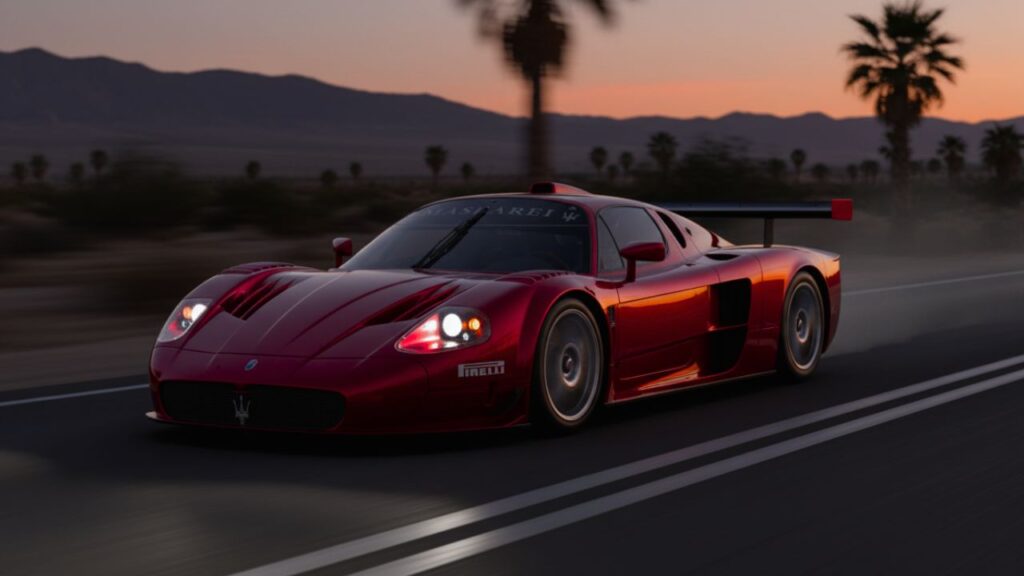
Following its GT1 success, Maserati launched the MC12 Corsa in 2006, a limited run of only 12 units reserved for select clients. This model mirrored the GT1 car’s performance but was designed for private track use rather than competition.
The Corsa carried an upgraded version of the 6.0-liter V12 producing nearly 755 hp, paired with an even lighter chassis and stripped-down interior. With performance nearly identical to its racing sibling, the MC12 Corsa remains one of the purest expressions of track engineering Maserati has ever created.
Lasting Legacy in Maserati’s History
The success of the Maserati MC12 reignited global attention on the brand. It reminded enthusiasts that Maserati could build not just elegant grand tourers but world-class performance machines.
Its influence is clear in Maserati’s later high-performance vehicles, particularly the Maserati MC20, which continues the MC12’s philosophy of blending motorsport technology with Italian luxury.
Two decades later, the MC12 remains a legend the car that brought Maserati back to victory lanes and back into the hearts of performance enthusiasts around the world.
Market Value and Collectibility of the Maserati MC12
Nearly two decades after its debut, the Maserati MC12 remains one of the most coveted collector cars ever produced. With only 50 road-legal examples built between 2004 and 2005, its rarity alone guarantees exclusivity. But beyond numbers, the MC12’s historical significance, Ferrari connection, and racing pedigree make it an investment-grade masterpiece.
Production Numbers and Exclusivity
Maserati produced just 50 MC12 Stradale units to homologate the GT1 race car. Each was meticulously hand-assembled in Modena, Italy, with a level of craftsmanship that reflected its $800,000 launch price an astronomical figure at the time.
The low production volume instantly made the MC12 more exclusive than the Ferrari Enzo, of which 399 units were produced. Its blend of rarity and competition heritage elevated it beyond a mere supercar it became a symbol of Italian engineering excellence.
Auction Records and Market Trends
In the modern collector market, the MC12’s value has soared.
Recent auction data shows examples fetching between $3.5 million and $4.8 million, depending on mileage, condition, and provenance. Cars with documented race lineage or low mileage can exceed $5 million.
Despite fluctuations in the hypercar market, the MC12 has shown steady appreciation, outpacing many of its contemporaries. Collectors view it as a historically significant model bridging two eras: classic analog engineering and the dawn of modern hypercars.
Factors Driving Collectibility
Several unique factors contribute to the MC12’s enduring appeal:
- Rarity: Only 50 road cars exist, making it one of the rarest modern Maseratis.
- Performance Pedigree: Proven GT1 dominance and Ferrari-derived engineering.
- Design Identity: A visually distinct, race-oriented silhouette unlike any other road car.
- Historical Importance: Maserati’s comeback car after nearly 40 years away from racing.
These traits have made it not just collectible but almost mythical the car that represents Maserati’s pinnacle of performance.
Influence on Modern Maserati Models
The MC12’s DNA continues in Maserati’s current flagship, the MC20, which follows a similar philosophy: lightweight engineering, carbon construction, and track-inspired dynamics.
For those interested in how Maserati’s modern models have evolved, see this detailed review of the spiritual successor to understand how the MC20 carries forward the performance legacy of the MC12.
That connection keeps the MC12 relevant in the modern automotive landscape. Collectors and enthusiasts often view the MC20 as a continuation of the MC12’s vision a purebred Maserati engineered for both passion and precision.
Investment Outlook
As time passes, the MC12’s value is expected to rise further. Limited supply, historical context, and desirability among collectors ensure that it will remain a blue-chip automotive asset. Few cars of the 21st century have achieved this blend of rarity, racing pedigree, and artistry and even fewer have aged with such prestige.
Pros and Cons of the Maserati MC12
The Maserati MC12 is often hailed as one of the greatest supercars ever built, but like any machine designed for perfection, it comes with trade-offs. Here’s a balanced view of what makes it exceptional and what limits its practicality.
Pros
- Unmatched Rarity: Only 50 road-going examples make it an ultra-exclusive collector’s item.
- Racing Pedigree: A proven GT1 championship winner, its engineering roots are pure motorsport.
- Timeless Design: The long, aerodynamic body remains one of the most striking supercar silhouettes ever made.
- Mechanical Purity: Naturally aspirated V12, rear-wheel drive, and analog feel a formula that’s almost extinct today.
- Investment Value: Steady appreciation in collector markets, often surpassing its Ferrari and Porsche rivals.
Cons
- Limited Practicality: Minimal ground clearance, no rear visibility, and a non-existent trunk.
- Maintenance Costs: Specialized service and parts availability make upkeep extremely expensive.
- Driving Challenge: The automated manual gearbox can be jerky in city conditions, demanding skilled handling.
- Regulatory Restrictions: Some regions (like the U.S.) require special exemptions for road legality.
- Accessibility: With values exceeding $4 million, ownership is limited to elite collectors.
The MC12 is not about convenience it’s about emotion, history, and performance purity. Those who own one aren’t just drivers; they’re curators of Maserati’s greatest achievement.
Competitor Comparisons of the Maserati MC12
The Maserati MC12 competed in a rarefied league of ultra-performance machines that defined early-2000s automotive excellence. Comparing it to its contemporaries reveals how Maserati carved a unique niche between artistry and racing engineering.
Ferrari Enzo vs Maserati MC12
Both cars share the same core engine and chassis, yet their personalities are distinct.
- Ferrari Enzo: Sharper, lighter, and more agile for track precision.
- Maserati MC12: Longer, more aerodynamic, and designed with GT endurance in mind.
Where the Enzo is a driver’s scalpel, the MC12 is a grand tourer with race-winning stamina.
Porsche Carrera GT vs Maserati MC12
The Carrera GT emphasized a raw, manual driving experience powered by a V10, while the MC12 offered a more forgiving and stable ride at high speeds.
- Porsche focused on engagement.
- Maserati focused on aerodynamic performance and grip.
The result: the MC12 feels more like a professional race car, while the Carrera GT feels more like a road-legal prototype.
McLaren F1 vs Maserati MC12
Although the McLaren F1 debuted a decade earlier, it remained the gold standard for analog supercars.
- The F1’s three-seat layout and lightweight engineering made it revolutionary.
- The MC12, in contrast, prioritized downforce and racing compliance.
The F1 was built for ultimate speed records, while the MC12 was designed for racing victory.
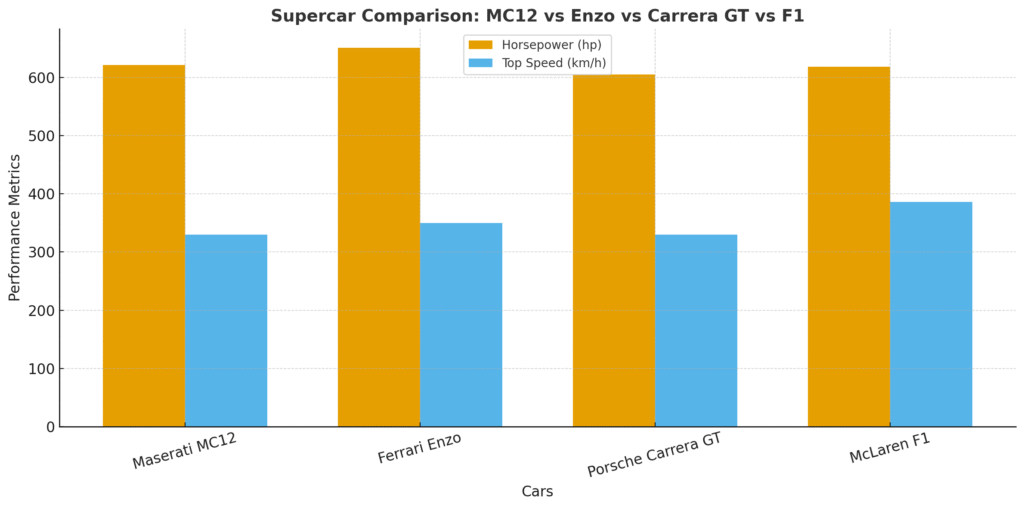
Spec Comparison Table
| Model | Engine | Power (hp) | 0–100 km/h | Top Speed | Units Made |
|---|---|---|---|---|---|
| Maserati MC12 | 6.0L V12 (NA) | 621 | 3.8 s | 330 km/h | 50 |
| Ferrari Enzo | 6.0L V12 (NA) | 651 | 3.6 s | 350 km/h | 399 |
| Porsche Carrera GT | 5.7L V10 (NA) | 603 | 3.9 s | 330 km/h | 1,270 |
| McLaren F1 | 6.1L V12 (NA) | 627 | 3.2 s | 386 km/h | 106 |
(NA = Naturally Aspirated)
Conclusion
The Maserati MC12 stands as one of the most significant supercars in automotive history. Born from racing necessity and sculpted with Italian flair, it combined artistry, performance, and exclusivity like few others ever have.
It wasn’t built to appeal to the masses it was designed to win races and revive Maserati’s identity as a performance legend. From its Ferrari-derived V12 to its championship victories, every part of the MC12 tells a story of engineering ambition and competitive success.
Two decades later, its spirit lives on through cars like the Maserati MC20, proving that the brand’s passion for speed and design remains as strong as ever. The MC12 is not just a car it’s a symbol of how far Maserati was willing to go to make history again.
FAQs About the Maserati MC12
How many Maserati MC12 cars were built?
Maserati built 50 road-legal MC12 units between 2004 and 2005, plus a small number of racing and Corsa variants.
What makes the Maserati MC12 different from the Ferrari Enzo?
While the two share a similar V12 engine and chassis, the MC12 is longer, more aerodynamic, and optimized for GT racing rather than pure road performance.
Is the Maserati MC12 street-legal?
Yes, but only in select regions. Some examples required special exemptions to comply with emissions and safety regulations.
How much does a Maserati MC12 cost today?
Auction values range from $3.5 million to over $5 million, depending on mileage, originality, and history.
What is the modern successor to the Maserati MC12?
The Maserati MC20 is widely regarded as the MC12’s spiritual successor, blending advanced aerodynamics with next-generation performance.