
Why Mercedes Reliability Is a Common Question
“Are Mercedes reliable?” is one of the most searched questions in the luxury-car world. The reason is simple. Mercedes-Benz sits at the intersection of advanced engineering, premium comfort, and cutting-edge technology. That combination delivers an exceptional driving experience, but it also raises concerns about long-term dependability, maintenance complexity, and ownership costs.
Unlike mainstream brands, Mercedes is judged not only on whether its cars start every morning, but on how well advanced features, safety systems, and high-performance components hold up over time. Reliability, in this context, is not a yes-or-no question. It depends on model, generation, powertrain, maintenance habits, and owner expectations.
This article takes a data-driven, experience-based approach to answer one question clearly and honestly: are Mercedes cars reliable in real-world ownership?
Understanding What “Reliable” Means for Luxury Cars
Before evaluating Mercedes reliability, it’s important to define what reliability actually means in the luxury segment.
For most buyers, reliability includes several layers. Short-term reliability refers to the likelihood of problems during the warranty period. Long-term reliability focuses on durability after five to ten years of use. There is also functional reliability, meaning how consistently advanced features such as infotainment, driver assistance, and air suspension work over time.
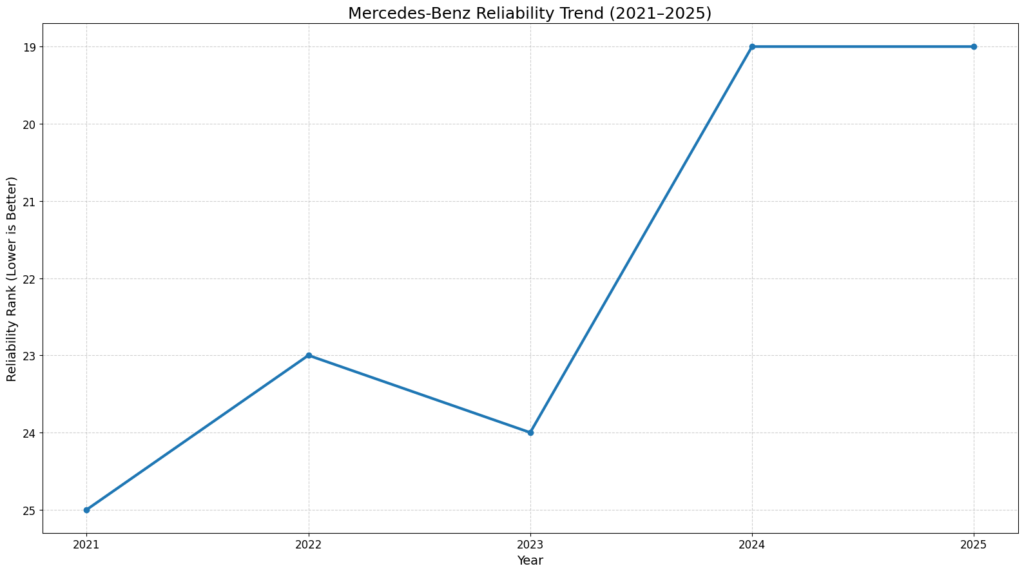
Luxury vehicles are inherently more complex than mainstream cars. More sensors, electronic modules, comfort systems, and performance-oriented components mean more potential failure points. As a result, a luxury car can feel less “reliable” even if its core mechanical systems are sound.
Mercedes reliability must therefore be judged differently from that of a basic commuter car. The question is not whether it will have issues, but whether those issues are manageable, predictable, and proportional to what the car offers.
Mercedes-Benz Brand Overview in a Reliability Context
Mercedes-Benz has built its reputation on engineering innovation. Many technologies now considered standard across the industry, such as anti-lock brakes, advanced airbags, and modern driver-assistance systems, first appeared in Mercedes vehicles.
This innovation-first approach has a direct impact on reliability. Mercedes often introduces new technologies earlier than competitors, which can lead to occasional early-generation issues. Over time, these systems tend to mature and become more dependable.
Another factor is engineering philosophy. Mercedes prioritizes ride comfort, safety, and performance over simplicity. Components are often over-engineered for performance but tightly packaged, which can increase repair complexity. This does not necessarily mean poor reliability, but it does mean higher sensitivity to maintenance quality.
In short, Mercedes aims for excellence first and simplicity second. Reliability is part of the equation, but not the sole design priority.
Are Mercedes Reliable Compared to Other Luxury Brands?
When compared to other luxury automakers, Mercedes generally ranks in the middle of the pack for reliability.
Against BMW, Mercedes shows similar patterns. Both brands offer strong engines and transmissions but can experience electronic and sensor-related issues as vehicles age. Audi follows a comparable trend, particularly with complex infotainment and all-wheel-drive systems.
Lexus, on the other hand, consistently outperforms Mercedes in reliability studies. This is largely due to Lexus using proven technology for longer periods and prioritizing durability over innovation speed.
The key takeaway is that Mercedes is not unreliable by luxury standards, but it is not the most dependable brand in the segment either. It trades some long-term simplicity for advanced features, driving refinement, and prestige.
Model-by-Model Reliability Differences in the Mercedes Lineup
One of the most important points often overlooked is that Mercedes reliability varies significantly by model.
Entry-level models tend to be more reliable overall because they use simpler engines, fewer luxury systems, and more cost-conscious components. Flagship models deliver unmatched comfort and technology, but their complexity can impact long-term dependability.
Sedans
The C-Class is often considered one of the more reliable Mercedes sedans. It balances modern technology with manageable complexity and is widely used as a daily driver.
The E-Class has a strong reputation for mechanical durability, particularly older generations. Newer versions introduce more technology, which improves comfort but adds potential failure points.
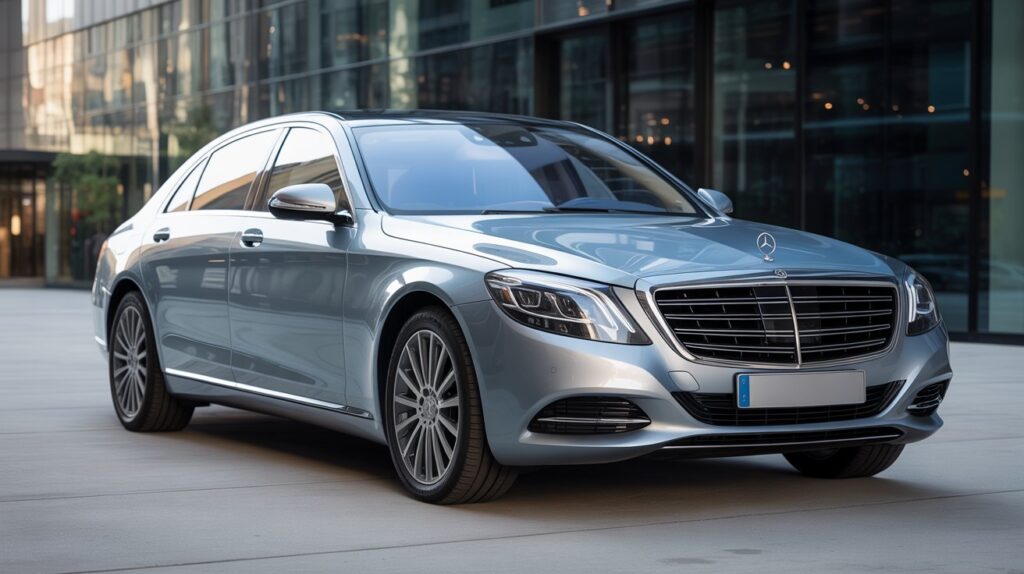
The S-Class represents the pinnacle of Mercedes engineering, but also the highest reliability risk. Advanced suspension systems, cutting-edge electronics, and luxury features can be costly to maintain as the car ages.
SUVs
Mercedes SUVs show similar patterns. The GLC and GLE are generally dependable when properly maintained and are popular choices for families.
The GLS, as a large luxury SUV, shares many traits with the S-Class. It delivers exceptional comfort but requires diligent maintenance to remain trouble-free.
The G-Class is mechanically robust, but its modern luxury upgrades mean it is no longer the simple, utilitarian vehicle it once was.
Performance Models (AMG)
AMG models are built for performance first. While their engines are often hand-assembled and mechanically strong, higher stress levels, aggressive tuning, and specialized components increase wear. Reliability is highly dependent on driving style and maintenance discipline.
Powertrain Reliability: Engines, Transmissions, and Drivetrains
Mercedes engines are generally regarded as strong and well-engineered. Many gasoline engines can exceed high mileage when serviced correctly. Diesel engines, where available, are known for durability but are sensitive to fuel quality and emissions system maintenance.
Automatic transmissions used by Mercedes have improved significantly over time. Earlier generations experienced occasional issues, but modern units are smoother and more dependable when serviced according to schedule.
The 4MATIC all-wheel-drive system is robust, though it adds complexity. Routine fluid changes and inspections are critical for long-term reliability.
Hybrid and mild-hybrid systems introduce new considerations. These systems improve efficiency but add electrical components that may increase long-term ownership costs once warranties expire.
Technology and Electronics: Strength and Weakness
Electronics are the most common source of reliability complaints among Mercedes owners.
The MBUX infotainment system is powerful and intuitive, but early versions experienced software glitches. Over time, updates have improved stability, though long-term reliability depends on software support and hardware durability.
Driver-assistance systems generally perform well but rely heavily on sensors and cameras. Minor sensor faults can trigger warning lights even when the vehicle is safe to drive.
Electrical complexity is the price of modern luxury. While these issues are often not catastrophic, they can be frustrating and expensive if they occur outside warranty coverage.
Maintenance, Ownership, and Running Costs
Mercedes reliability is closely tied to maintenance. Skipping services or using low-quality parts significantly increases the risk of problems.
Maintenance costs are higher than average, especially at dealerships. However, using reputable independent specialists can reduce expenses without sacrificing reliability.
Owners who follow service intervals strictly often report long, trouble-free ownership. Those who treat a Mercedes like an economy car frequently encounter issues that damage the brand’s reliability reputation.
For buyers comparing future ownership trends and European brand strategies, understanding how manufacturers approach durability and maintenance planning is essential, especially when evaluating upcoming European car models and ownership trends.
Common Mercedes Reliability Complaints Explained
Many reported issues are not severe mechanical failures but rather comfort or electronic faults.
Electrical warning messages, air suspension wear, and sensor malfunctions are common themes. Engine oil leaks and cooling system components can also require attention as mileage increases.
Importantly, many complaints are highly model-year specific. A problematic generation does not necessarily reflect the reliability of the brand as a whole.
Understanding this distinction helps buyers make informed decisions rather than relying on generalized brand perceptions.
Longevity: How Long Do Mercedes Cars Typically Last?
With proper maintenance, many Mercedes vehicles can reach high mileage benchmarks, often exceeding 200,000 kilometers and in some cases significantly more.
Longevity depends on usage patterns, service history, and climate. Vehicles driven gently and serviced on time tend to age gracefully, while neglected cars develop issues quickly.
Mercedes cars are built to last, but they demand commitment from their owners. Longevity is achievable, but not effortless.
Ownership Experience by Region
Reliability perception varies globally. In regions with strong service networks and high-quality fuel, Mercedes ownership tends to be more positive.
In emerging markets, limited access to trained technicians and genuine parts can negatively affect reliability impressions. Climate extremes also influence electronic and suspension durability.
This regional variation explains why Mercedes reliability opinions differ so widely across markets.
Data and Reference Section: Mercedes Reliability Insights
Reliability Trend Overview
| Category | Mercedes-Benz | Luxury Segment Average |
|---|---|---|
| Mechanical durability | Strong | Strong |
| Electronics reliability | Moderate | Moderate |
| Long-term ownership | Maintenance-dependent | Maintenance-dependent |
Ownership Cost Breakdown (Estimated)
| Cost Category | Relative Level |
|---|---|
| Scheduled maintenance | High |
| Repairs after warranty | Moderate to high |
| Parts availability | Good globally |
Technology Complexity vs Failure Risk
| Vehicle Type | Complexity | Reliability Risk |
|---|---|---|
| Entry-level ICE models | Moderate | Lower |
| Hybrid models | High | Moderate |
| Flagship luxury trims | Very high | Higher |
Are Mercedes Reliable for Daily Use?
For daily driving, Mercedes vehicles are reliable when used as intended and maintained properly. They excel in comfort, safety, and refinement, making them excellent daily drivers for owners who understand the maintenance commitment.
First-time luxury buyers should start with simpler models and avoid over-optioned trims if reliability is a top priority.
How to Choose a Reliable Mercedes Model
Selecting the right model year and powertrain is critical. Proven engines, moderate trim levels, and full service records significantly improve ownership satisfaction.
Certified Pre-Owned vehicles offer added peace of mind through extended warranties and thorough inspections, making them a safer entry point into Mercedes ownership.
FAQs About Mercedes Reliability
Are Mercedes cars reliable long-term?
Yes, when properly maintained, many Mercedes vehicles offer strong long-term durability, though costs are higher than average.
Is Mercedes more reliable than BMW or Audi?
Reliability is broadly similar across German luxury brands, with differences depending more on model and generation than brand.
Which Mercedes model is the most reliable?
Historically, simpler models such as the C-Class and E-Class with proven engines tend to be more reliable.
Are older Mercedes more reliable than newer ones?
Older models benefit from simpler electronics, while newer models offer better safety and efficiency but increased complexity.Is Mercedes reliability improving?
Mechanical reliability has improved over time, while electronic complexity remains the main challenge.
Conclusion: Are Mercedes Reliable or Just High-Maintenance?
Mercedes cars are not unreliable, but they are demanding. They reward owners with exceptional comfort, performance, and innovation, while requiring disciplined maintenance and realistic expectations.
If you value advanced technology, driving refinement, and brand prestige, Mercedes can be a reliable long-term choice. If low ownership cost and minimal involvement are your top priorities, a simpler brand may be a better fit.
Reliability with Mercedes is less about luck and more about informed ownership.
Pingback: 2026 Mercedes-Benz C-Class: Redefining the Modern Luxury Compact Sedan -