
China’s automotive landscape is changing faster than ever, and BYD sits right at the center of that transformation. The BYD Qin L is the brand’s latest entry into the mid-size sedan category, designed to bridge the gap between affordability, efficiency, and smart technology. As a key addition to BYD’s expanding Qin lineup, the Qin L combines sleek styling, modern connectivity, and both plug-in hybrid (DM-i) and full electric (EV) powertrains to appeal to a wide audience. The model reflects how BYD continues to push boundaries in electrified mobility while keeping its focus on practical value and long-range performance. Launched in early 2025, the Qin L represents BYD’s strategy to strengthen its mid-range offerings alongside premium models like the Han L and Seal DM-i. Whether buyers choose the fuel-efficient hybrid or the all-electric variant, the Qin L aims to deliver a driving experience that blends innovation, comfort, and intelligent design all at a price point that challenges global competitors.
Table of Contents
What is the BYD Qin L?
The BYD Qin L is a mid-size sedan that marks a new era for BYD’s Qin family, sitting above the Qin Plus but below the larger Han L in the company’s lineup. It was officially launched in China in March 2025, available in both plug-in hybrid (DM-i) and full electric (EV) versions. This dual-powertrain strategy gives buyers the flexibility to choose between BYD’s latest fifth-generation hybrid system or its advanced e-Platform 3.0 Evo architecture for pure electric performance.
The Qin L EV version features two single-motor setups: a 110 kW (148 hp) variant paired with a 46.08 kWh battery offering a CLTC range of about 470 km, and a 160 kW (215 hp) model with a larger 56.64 kWh battery that stretches the range to around 545 km. The plug-in hybrid version, known as the Qin L DM-i, combines a 1.5-liter petrol engine with an electric motor and BYD’s latest Blade Battery technology. It can achieve up to 2,100 km of combined range under Chinese testing conditions, although real-world results may vary.
Dimensionally, the Qin L measures around 4,830 mm long, 1,900 mm wide, and 1,495 mm tall, with a wheelbase of 2,790 mm for the hybrid and slightly longer for the EV version. This positions it squarely in the mid-size segment, offering a roomier cabin than the compact Qin Plus while remaining more affordable than the luxury-oriented Han L.
With its blend of modern design, cutting-edge powertrain options, and strong efficiency figures, the BYD Qin L aims to challenge established players like the Toyota Camry Hybrid and Tesla Model 3 Standard Range within its price class, at least in the domestic market.
Design and Interior Highlights
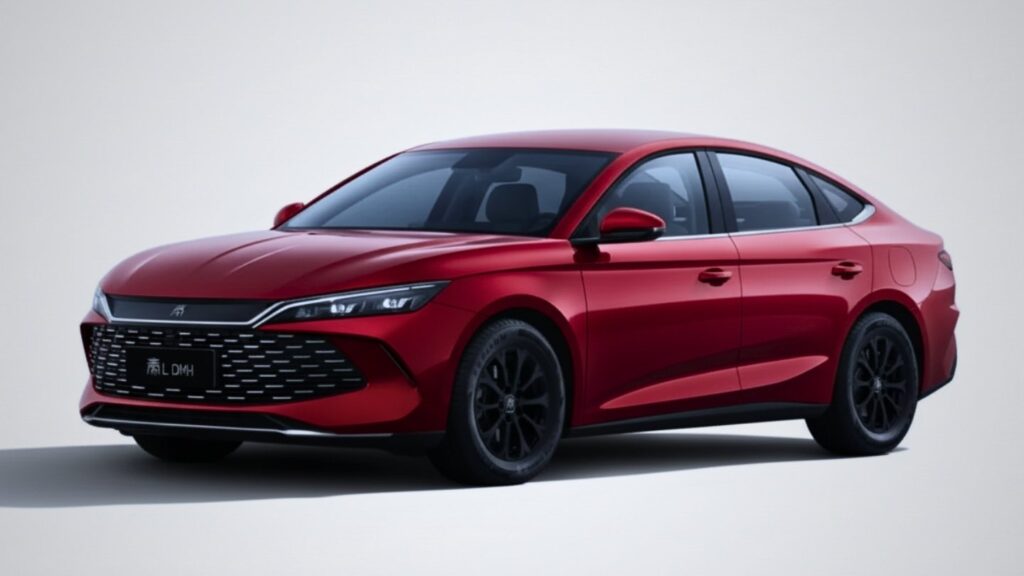
The BYD Qin L showcases a mature, confident design that signals BYD’s growing mastery in modern automotive styling. It merges aerodynamic precision with elegant proportions, resulting in a mid-size sedan that looks both futuristic and refined. The design not only enhances visual appeal but also improves efficiency, contributing to the Qin L’s impressive range and performance figures.
Exterior Design
The exterior follows BYD’s latest “Dragon Face” philosophy, featuring sleek LED headlights, a bold stance, and flowing body lines. The EV variant adopts a closed-off front for improved aerodynamics, while the plug-in hybrid version (DM-i) retains a subtle intake for cooling efficiency. Measuring about 4,830 mm in length and 1,900 mm in width, the Qin L’s proportions align it with competitors like the Toyota Camry and Hyundai Sonata. At the rear, full-width taillights and a sculpted trunk lid emphasize its width and stability, while 17- or 18-inch alloy wheels give it a sporty, premium look.
Interior Experience
Inside, the Qin L continues BYD’s focus on technology and comfort. The centerpiece is a 15.6-inch rotating touchscreen, capable of switching between portrait and landscape modes for added convenience. Soft-touch materials, chrome accents, and ambient lighting create a luxurious atmosphere that rivals higher-priced sedans. The cabin design is minimal yet elegant, emphasizing functionality with a futuristic flair.
Comfort and Space
The Qin L’s cabin is designed with families and long-distance drivers in mind. With a wheelbase of around 2,820 mm, rear passengers enjoy generous legroom and headroom. The EV’s flat floor enhances interior space, while the hybrid model still offers excellent comfort and support. Trunk capacity is practical, suitable for daily commutes or road trips, with split-folding rear seats adding flexibility.
Build Quality and Materials
BYD has made noticeable improvements in craftsmanship. Materials such as synthetic leather, soft padding, and solid switchgear elevate the Qin L above typical expectations for its price range. Panel alignment is precise, and insulation effectively reduces road and wind noise. Even in lower trims, the build quality reflects BYD’s growing confidence as a global manufacturer.
Powertrain and Performance
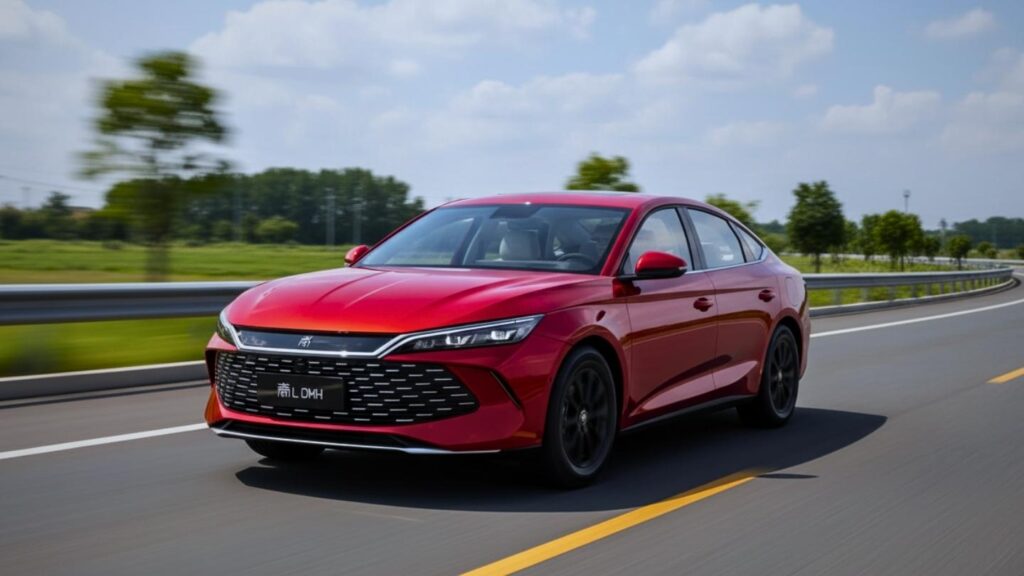
The BYD Qin L delivers a dynamic blend of efficiency and performance through two advanced powertrain options: an all-electric (EV) model and a plug-in hybrid (DM-i) version. Both configurations demonstrate BYD’s engineering progress in electrified mobility, combining range, refinement, and smooth driving characteristics suited for modern roads.
BYD Qin L EV Performance
The fully electric BYD Qin L EV is powered by a single motor configuration available in two output levels. The base variant uses a 110 kW (148 hp) motor paired with a 46.08 kWh Blade Battery, achieving up to 470 km of range on the CLTC cycle. The higher variant produces 160 kW (215 hp) with a 56.64 kWh battery, extending range to around 545 km. These figures position the Qin L EV as a practical long-distance commuter with quick torque delivery and silent operation. Acceleration is brisk for its class, while regenerative braking and optimized aerodynamics further enhance energy efficiency.
BYD Qin L DM-i Hybrid Efficiency
The plug-in hybrid version, known as the BYD Qin L DM-i, utilizes the brand’s fifth-generation DM-i Super Hybrid system. It pairs a 1.5-liter gasoline engine with an electric motor and BYD’s lithium iron phosphate (LFP) Blade Battery. Claimed fuel consumption is as low as 2.9 L/100 km under Chinese testing conditions, with a combined range of up to 2,100 km on a full battery and fuel tank. Real-world reports suggest consumption around 4.5 L/100 km, which is still remarkably efficient for a mid-size sedan. The system prioritizes electric drive for most urban trips, engaging the engine mainly at higher speeds or when additional power is required.
Driving Experience and Handling
Behind the wheel, the Qin L emphasizes comfort and smoothness rather than aggressive performance. Both EV and DM-i variants deliver responsive acceleration, light steering, and stable cornering behavior. The chassis tuning offers a balanced mix of ride comfort and body control, making it suitable for daily commuting and long journeys alike. BYD’s integrated control system manages suspension damping, torque response, and regenerative braking seamlessly, ensuring a refined and predictable driving experience.
Charging and Refueling Convenience
Charging times vary depending on the configuration. The Qin L EV supports DC fast charging, capable of replenishing from 30% to 80% in roughly 30 minutes. Home AC charging can fully charge the battery overnight. The hybrid variant offers the flexibility of refueling in minutes while still benefiting from short electric-only trips in city driving. Together, these systems make the Qin L one of the most versatile mid-size sedans in its class, combining clean energy with convenience.
Technology and Safety Features
The BYD Qin L continues the brand’s tradition of integrating intelligent systems and advanced safety features, positioning it as one of the most technologically complete sedans in its class. From its infotainment interface to driver-assist systems, every feature has been designed to enhance connectivity, comfort, and driver confidence.
Infotainment and Connectivity
The Qin L’s interior is centered around BYD’s intelligent DiLink infotainment system. The large 15.6-inch rotating touchscreen supports Android and iOS connectivity, Bluetooth, Wi-Fi hotspot capability, and over-the-air (OTA) software updates. Voice recognition allows drivers to control navigation, air conditioning, and media without taking their hands off the wheel. The system also supports remote vehicle monitoring and smart home integration, allowing users to adjust in-car settings or start climate control from a smartphone app.
Smart Driving and ADAS
BYD has equipped the Qin L with a range of advanced driver-assistance systems under its DiPilot suite. Depending on the trim, features include adaptive cruise control, lane departure warning, lane keeping assist, automatic emergency braking, and blind-spot detection. The EV variant also introduces “God’s Eye” intelligent driving capability, which enhances camera and sensor coverage for smoother semi-autonomous driving in traffic. Parking sensors, a 360-degree camera, and intelligent parking assist make urban maneuvering effortless.
Battery and Platform Technology
The electric version of the Qin L is built on BYD’s latest e-Platform 3.0 Evo, designed for high efficiency and structural rigidity. This platform supports faster charging, improved thermal management, and better crash protection. Both EV and DM-i models use BYD’s proprietary Blade Battery, known for its exceptional safety and long lifespan. The battery pack design resists puncture and overheat damage, providing extra peace of mind for owners.
Safety Structure and Build Integrity
BYD prioritizes safety with reinforced body architecture, multiple crumple zones, and extensive use of high-strength steel. The Qin L comes equipped with multiple airbags, ISOFIX mounts, and electronic stability control as standard. The brand’s reputation for robust engineering extends to battery protection, with each pack enclosed in a fire-resistant casing. These systems work together to give the Qin L a strong safety profile comparable to global competitors.
Price, Value, and Market Position
The BYD Qin L has been introduced as an affordable yet sophisticated mid-size sedan designed to bridge the gap between economy and premium hybrid/electric models. It offers exceptional efficiency, innovative technology, and refined styling at a highly competitive price point, making it one of the strongest contenders in China’s fast-growing new energy vehicle (NEV) market.
Pricing and Trim Levels
As of mid-2025, the BYD Qin L DM-i plug-in hybrid starts at approximately CNY 100,000–150,000 (USD 13,800–20,700), depending on configuration. The full electric Qin L EV is expected to cost slightly higher, starting near CNY 160,000 (USD 22,000). Each variant offers multiple trim levels that differ in range, features, and connectivity options, giving buyers the flexibility to choose between affordability and luxury.
Value Proposition
The Qin L’s main advantage lies in its remarkable fuel economy, thanks to BYD’s latest fifth-generation DM-i hybrid system. With a combined range exceeding 2,000 km (about 1,240 miles) for the hybrid version, it stands out as one of the most efficient sedans in its price class. Additionally, the model’s strong warranty coverage, modern design, and comprehensive tech package make it a high-value option for young professionals and families seeking a reliable daily driver.
Market Position and Competitors
The BYD Qin L competes in China’s compact-to-mid-size segment against rivals like the Geely Emgrand L Hi·P, Changan Qiyuan A05, and Toyota Corolla Hybrid. However, BYD’s proprietary hybrid system, advanced software integration, and growing brand trust give the Qin L a distinct edge. Its combination of affordability, range, and safety make it a potential global export candidate as BYD expands internationally.
While the Qin L focuses on affordability and practicality, the BYD Han L 2025 serves as BYD’s luxury flagship sedan, showcasing the brand’s premium technology and design philosophy.
Pros and Cons of the BYD Qin L
The BYD Qin L offers an appealing combination of efficiency, modern styling, and advanced technology, but like any vehicle, it comes with a few trade-offs. This section outlines the strengths and weaknesses to help potential buyers make an informed choice.
Pros
- Exceptional Fuel Efficiency: The fifth-generation DM-i hybrid system achieves extremely low fuel consumption, with a range exceeding 2,000 km per tank.
- Advanced Technology: DiLink infotainment and DiPilot ADAS features make the Qin L one of the most connected cars in its class.
- Attractive Pricing: Competitively priced between 100,000 and 160,000 CNY, it delivers outstanding value for money.
- Smooth and Quiet Ride: Excellent NVH (noise, vibration, harshness) control ensures a refined driving experience.
- Stylish Design: The “Dragon Face” design language and premium interior materials enhance the overall impression.
Cons
- Limited Global Availability: The Qin L is primarily available in China, with no confirmed international release.
- Performance Not Focused on Sportiness: While efficient, the power delivery prioritizes economy over excitement.
- Unverified Long-Term Durability: As a newer model, real-world reliability data is still limited.
Competitor and Alternative Comparisons
The BYD Qin L competes in the increasingly crowded market of electrified sedans, where hybrid and EV technologies overlap. Here’s how it compares to key rivals in 2025.
Geely Emgrand L Hi·P
- Powertrain: Plug-in hybrid setup similar to Qin L but with slightly less range.
- Interior Quality: Modern but lacks the smart display rotation and software richness of BYD’s DiLink.
- Verdict: Geely’s offering is solid but falls short on tech integration and range efficiency.
Changan Qiyuan A05
- Performance: Offers slightly quicker acceleration but lower efficiency.
- Tech Suite: Good connectivity options but less intuitive than BYD’s system.
- Verdict: Sportier to drive, yet less refined overall.
Toyota Corolla Hybrid
- Fuel Efficiency: Globally renowned for economy but less advanced in plug-in options in this price range.
- Price and Availability: More expensive in many markets compared to Qin L.
- Verdict: Toyota’s reliability is unmatched, but BYD’s tech innovation and affordability give it an edge in value.
Comparison Table: BYD Qin L vs Competitors
| Model | Powertrain | Range (Hybrid/EV) | Price (CNY) | Notable Feature |
|---|---|---|---|---|
| BYD Qin L | DM-i Hybrid / EV | 2,000 km (Hybrid) | 100,000–160,000 | Blade Battery, DiLink Infotainment |
| Geely Emgrand L Hi·P | Hybrid | 1,300 km | 120,000–150,000 | Good comfort, lower tech |
| Changan Qiyuan A05 | Hybrid | 1,100 km | 110,000–140,000 | Sporty design |
| Toyota Corolla Hybrid | Hybrid | 1,000 km | 160,000–180,000 | Global reliability |
FAQs About the BYD Qin L
What is the fuel efficiency of the BYD Qin L DM-i hybrid?
The Qin L DM-i hybrid achieves a combined range of up to 2,100 km (approximately 1,300 miles) per tank, making it one of the most fuel-efficient sedans in its category.
Is the BYD Qin L available as a full electric vehicle?
Yes, BYD plans to launch an all-electric Qin L EV based on the e-Platform 3.0 Evo, offering improved performance and faster charging times.
How fast can the Qin L accelerate?
The hybrid version reaches 0–100 km/h in around 7.5 seconds, prioritizing smoothness and efficiency over sporty performance.
What are the interior features of the BYD Qin L?
It includes a rotating 15.6-inch touchscreen, digital instrument cluster, premium synthetic leather seats, and a full suite of driver-assist systems.
Will the BYD Qin L be sold internationally?
As of 2025, BYD has not announced a global release, but expansion to select markets in Asia, Europe, and South America is expected within the next two years.
Conclusion
The BYD Qin L is a testament to how far BYD has advanced in hybrid and EV innovation. Combining sleek aesthetics, class-leading fuel efficiency, and intelligent technology, it sets a new standard for affordable electrified sedans. While it may lack global availability and outright sporty performance, the Qin L’s refined comfort, robust safety systems, and exceptional efficiency make it a compelling choice for modern drivers in China’s competitive NEV market.
Pingback: 2026 Tesla Model 3 Review With New Range Boost And Returning Stalk Controls -