
Why the Xiaomi SU7 Matters
Xiaomi has long been known for shaking up the tech world with smartphones, smart home devices, and AI-powered gadgets. Now the brand is aiming even higher with something far more ambitious, its first all-electric performance sedan, the Xiaomi SU7. This marks a bold new chapter for the company as it moves from consumer electronics into the fast-growing world of electric mobility.
When Xiaomi’s CEO Lei Jun first announced the project, many doubted whether a tech brand could build a competitive car from the ground up. Yet, within just a few years, Xiaomi’s vision has turned into reality. The SU7 was unveiled in late 2023 and officially launched in 2024, instantly drawing global attention for its sleek design, record-breaking speed, and integration with Xiaomi’s digital ecosystem.
What makes the SU7 so fascinating is how it combines cutting-edge EV engineering with the kind of smart connectivity you’d expect from a phone manufacturer. It promises blistering acceleration, AI-based driving assistance, and deep integration with Xiaomi’s software and devices, allowing drivers to control home systems, devices, and car features from a single interface.
More than just a new electric car, the Xiaomi SU7 represents a turning point for China’s car industry. It positions Xiaomi among a growing list of tech companies entering the EV market, standing shoulder to shoulder with players like Tesla, BYD, and NIO. For Xiaomi fans, it is also a glimpse of the brand’s future beyond screens and smartphones, showcasing how its design language and innovation philosophy can extend into mobility.
In the following sections, we’ll explore what makes the SU7 such a standout debut, from its design and technology to its performance, pricing, and how it stacks up against the competition.
Table of Contents
Model Overview and Variants of the Xiaomi SU7
The Xiaomi SU7 lineup showcases how the brand has carefully planned its entry into the EV world, offering several trims to suit different buyers. From the standard model to the high-performance Ultra, Xiaomi has built a range that combines smart technology, modern design, and thrilling power across all versions.
Launch Timeline and Development Background
Xiaomi first unveiled the SU7 to the public in December 2023. After months of anticipation, official sales began on March 28, 2024, in China. The company’s production base in Beijing was designed specifically for its automotive division, marking a major expansion beyond electronics. In just a few days after launch, Xiaomi received tens of thousands of preorders, confirming strong demand and consumer confidence in the new venture.
Variants of the Xiaomi SU7
Xiaomi launched multiple trims under the SU7 nameplate: the Standard, Pro, Max, and Ultra.
Each model builds on the same foundation but targets a unique driving experience.
- SU7 Standard: The entry model uses a single rear motor delivering 220 kW (299 hp) and around 400 Nm of torque. Its battery is a 73.6 kWh LFP pack that offers a CLTC-rated range of about 668 km.
- SU7 Pro: Upgrades include dual motors for all-wheel drive, a larger 94.3 kWh battery, and higher total output for faster acceleration.
- SU7 Max: Focuses on a balance of luxury and performance with enhanced suspension, premium materials, and improved AI-assisted driving.
- SU7 Ultra: The top-tier model pushes performance into supercar territory. With up to three motors and a system output of roughly 1,100 kW, it reaches 100 km/h in just under two seconds, making it one of the fastest production sedans in the world.
Positioning in the Market
The Xiaomi SU7 was designed to rival established EVs such as the Tesla Model 3, Porsche Taycan, and BYD Seal. Xiaomi’s goal was to create a vehicle that delivers world-class speed and comfort while keeping pricing relatively competitive. By blending technology from its consumer products with advanced automotive engineering, the brand has created a car that feels familiar to its fans yet completely new in concept.
Production and Availability
All Xiaomi SU7 models are currently produced in China, with deliveries starting in 2024. The company has stated that international expansion will follow once domestic production stabilizes, with a target window of around 2027 for European markets. Early reports indicate that Xiaomi plans to maintain tight integration between its automotive software and mobile ecosystem, giving global users a unified experience once the car reaches their region.
Design and Technology Highlights of the Xiaomi SU7
The Xiaomi SU7 is not just another electric sedan, it’s a showcase of Xiaomi’s design innovation and software intelligence. From its aerodynamic silhouette to the tech-filled cabin, every detail reflects the company’s deep roots in consumer technology and modern design.
Exterior Design and Aerodynamics
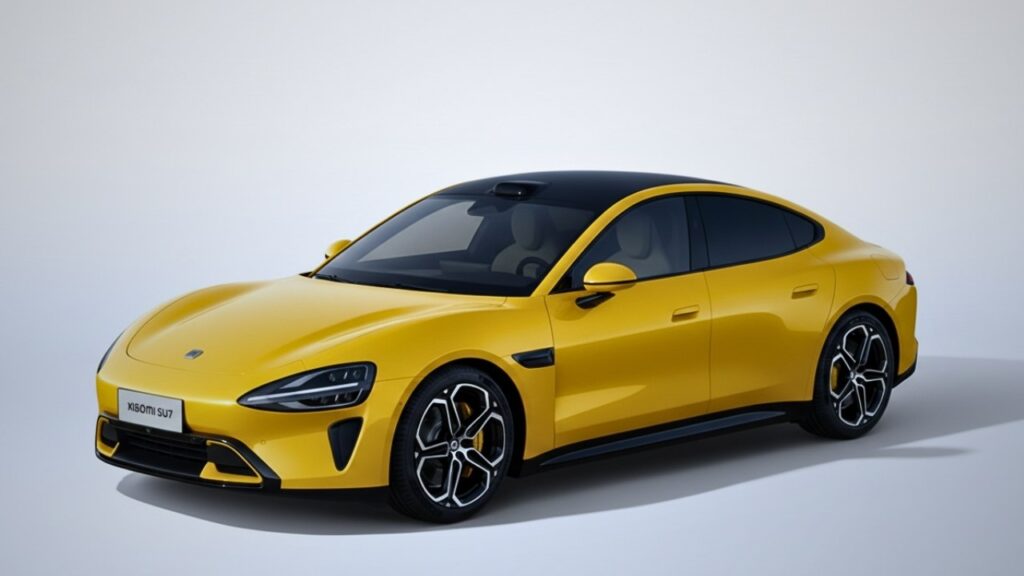
Xiaomi designed the SU7 with a focus on sleek proportions and aerodynamic efficiency. The car measures around 4,997 mm in length, 1,963 mm in width, and features a long 3,000 mm wheelbase. Its coupe-like roofline, clean side profile, and retractable door handles contribute to a drag coefficient as low as 0.195 Cd one of the lowest among production sedans.
Up front, the SU7 carries a sharp, aggressive look with narrow LED headlights and a wide air intake that cools its power electronics and battery pack. The Ultra variant adds active aerodynamic components, including a deployable rear spoiler and adaptive vents that improve stability at high speeds. These touches not only enhance performance but also emphasize the car’s futuristic identity.
Interior Design and Comfort
Inside the Xiaomi SU7, the cabin follows a minimalist yet premium aesthetic. The driver-focused layout features a large 16.1-inch central display, a 7.1-inch instrument cluster, and a 56-inch head-up display that projects real-time data across the windshield. The entire interface runs on Xiaomi’s HyperOS, which connects seamlessly with phones, tablets, and smart home devices.
Soft-touch materials, Alcantara trims, and ambient lighting create a refined atmosphere, while ergonomic seating ensures long-distance comfort. The use of recycled and sustainable materials further strengthens Xiaomi’s focus on eco-friendly luxury. The panoramic glass roof and frameless doors add to the sense of openness, giving the cabin a futuristic, high-end feel.
Connectivity and Smart Features
As expected from a company known for digital ecosystems, the Xiaomi SU7 is loaded with smart technology. HyperOS enables cross-device functionality, allowing users to mirror their phone apps, transfer data, or even control smart home appliances directly from the infotainment screen.
The car also supports over-the-air updates, AI-based driver assistance, and an advanced Level 2+ system that monitors traffic conditions, lane changes, and adaptive cruise in real time. A facial recognition system automatically adjusts the driver’s settings, seat position, and climate preferences as soon as they enter the car.
Chassis and Build Quality
Underneath, the Xiaomi SU7 rides on an aluminum-intensive frame for optimal strength and reduced weight. The chassis was developed to deliver both agility and comfort, supported by double wishbone front and multi-link rear suspension. Higher trims come with air suspension and adaptive dampers, improving handling on varying road conditions. Xiaomi’s engineers worked with top suppliers such as CATL and Bosch to fine-tune safety systems and performance hardware, ensuring the car meets global quality standards.
Infotainment Experience and User Interface
One of the biggest talking points is the SU7’s infotainment experience. The HyperOS platform delivers smartphone-level responsiveness and allows multiple passengers to connect their devices at once. Voice control, navigation integration with Xiaomi Maps, and compatibility with third-party apps like Spotify or Apple Music make daily driving more convenient.
Even more impressively, Xiaomi has integrated its Mi Home ecosystem, letting owners check their home cameras, lights, or air conditioning directly from the vehicle’s dashboard a feature that perfectly blends smart living with smart mobility.
Powertrain, Battery, and Performance of the Xiaomi SU7
Performance is where the Xiaomi SU7 truly shines. With powerful motors, cutting-edge battery technology, and lightning-fast acceleration, it proves that Xiaomi is not just building an electric car but a performance benchmark in the EV world.
Powertrain Options and Motor Configurations
The Xiaomi SU7 lineup offers multiple powertrain setups to cater to a wide range of drivers.
The Standard model uses a single rear-mounted motor producing 220 kW (299 hp) and around 400 Nm of torque. This setup allows the sedan to sprint from 0 to 100 km/h in about 5.3 seconds, giving it solid performance for an entry-level EV.
The Pro and Max variants feature dual-motor all-wheel-drive configurations. Power increases significantly, with combined outputs ranging from 425 kW (570 hp) to over 600 hp depending on the trim. These models deliver rapid acceleration and confident traction in all weather conditions.
Then comes the top-tier Xiaomi SU7 Ultra, a performance monster powered by a tri-motor system. Two motors at the rear and one at the front produce a combined output of approximately 1,138 kW (about 1,525 hp). This setup launches the car from 0 to 100 km/h in just under two seconds, making it one of the fastest sedans ever produced. The SU7 Ultra has recorded a Nürburgring lap time of 7:04.957, surpassing many renowned performance EVs.
Battery Technology and Architecture
Battery innovation is another strength of the Xiaomi SU7. The base model is equipped with a 73.6 kWh lithium-iron-phosphate (LFP) battery supplied by CATL, while higher trims use a 94.3 kWh NMC pack for longer range. The Ultra version features CATL’s Qilin 2.0 battery integrated with an 800V+ architecture, allowing exceptional charging speeds and energy density.
In ideal conditions, the SU7 Ultra can charge from 10 to 80 percent in about 11 minutes using a 490 kW DC fast charger. This makes it one of the fastest-charging production EVs available today. Xiaomi has also equipped the vehicle with an advanced thermal management system that regulates temperature across battery cells for consistent performance, even during intense driving sessions.
Range and Efficiency
Depending on configuration, the Xiaomi SU7 offers between 668 km and 830 km of range based on China’s CLTC testing cycle. Real-world figures may vary, but even conservative estimates place it among the longest-range EVs in its class. The optimized aerodynamics and regenerative braking system further enhance efficiency during daily commutes or highway drives.
The car’s intelligent energy management system adjusts power output according to driving habits, navigation data, and elevation, ensuring the best possible range in any scenario.
Driving Dynamics and Handling

Beyond straight-line speed, Xiaomi focused heavily on handling precision. The SU7’s near-perfect weight distribution and low center of gravity provide confident cornering stability. High-performance variants feature air suspension with adaptive damping and rear-wheel steering for added agility at both high and low speeds.
Xiaomi’s engineers worked with established suppliers like Bosch to refine steering response and braking feel. The result is a car that doesn’t just accelerate fast but also feels balanced and controllable, whether on city streets or on a racetrack.
Noise, Vibration, and Comfort
Although performance is the headline, comfort is not compromised. The cabin remains quiet even under heavy acceleration thanks to improved sound insulation and vibration damping. Xiaomi’s proprietary software tunes the cabin acoustics, generating a subtle “performance soundscape” that enhances the driving experience without artificial noise.
Pricing, Market Availability, and Launch Strategy of the Xiaomi SU7
The Xiaomi SU7 is positioned as a premium yet attainable electric sedan that undercuts its global rivals in price while delivering flagship performance. Xiaomi’s entry strategy focuses on offering advanced EV technology at a price point that appeals to both luxury and tech-savvy consumers.
Official Pricing Breakdown
At launch in China, the pricing structure was as follows:
- Xiaomi SU7 Standard – Around ¥215,900 (approx. $29,900 USD)
- Xiaomi SU7 Pro – Around ¥245,900 (approx. $33,900 USD)
- Xiaomi SU7 Max – Around ¥299,900 (approx. $41,000 USD)
- Xiaomi SU7 Ultra – Estimated at ¥499,000+ (approx. $68,000 USD)
This competitive pricing gives Xiaomi a major advantage against EVs such as the Tesla Model 3, NIO ET5, and Porsche Taycan. The brand’s strategy mirrors how it entered the smartphone market combining high-end specs with lower-than-expected pricing to capture attention and market share quickly.
Global Expansion Plan
Currently, the Xiaomi SU7 is available exclusively in China, but Xiaomi has confirmed intentions to enter select European markets by 2027. Regions such as Germany, Norway, and the Netherlands are likely early candidates due to their advanced EV infrastructure.
Xiaomi’s CEO Lei Jun has stated that global expansion will follow once production capacity stabilizes and software localization for international users is fully optimized.
Production and After-Sales Support
Production of the Xiaomi SU7 takes place at Xiaomi’s intelligent manufacturing plant in Beijing, capable of producing 200,000 vehicles per year. The factory uses 900 industrial robots and AI-based quality control for high precision.
To support buyers, Xiaomi plans to integrate SU7 servicing into its existing retail network. Owners will be able to manage maintenance, software updates, and smart home synchronization directly from their Xiaomi smartphones or through the HyperOS system.
Interior, Infotainment, and Smart Features of the Xiaomi SU7
The cabin of the Xiaomi SU7 feels more like a luxury tech lounge than a traditional car interior. The design blends simplicity, digital integration, and comfort with materials that reflect modern minimalism.
Cabin Design and Comfort
Inside, the SU7 offers a spacious layout with premium upholstery, ambient lighting, and a panoramic glass roof. The seats are ergonomically designed with ventilation, heating, and massage features on higher trims. The Ultra variant adds Nappa leather and a carbon-fiber interior package, enhancing both luxury and sportiness.
The minimalist dashboard layout emphasizes Xiaomi’s design philosophy of “less distraction, more connection.” Physical buttons are kept to a minimum, replaced by digital touch controls and voice commands through Xiaomi’s HyperOS assistant.
Infotainment and Connectivity
At the heart of the Xiaomi SU7’s infotainment system is a 16.1-inch 3K touchscreen display running HyperOS, the same ecosystem used in Xiaomi’s phones and smart devices. A secondary 7.1-inch digital instrument cluster provides essential driving data, while a retractable 56-inch AR-HUD projects navigation and speed information onto the windshield.
Passengers can also connect their Xiaomi phones, tablets, or even home devices, controlling smart appliances remotely from the car. With 5G connectivity and OTA (Over-the-Air) updates, the SU7 ensures that features and performance improvements continue to evolve long after purchase.
Audio and In-Car Entertainment
Audiophiles will appreciate the 25-speaker Dolby Atmos sound system in the upper trims. Xiaomi’s AI Soundscape adjusts the audio dynamically based on speed and road conditions for an immersive experience.
Rear passengers can also enjoy optional entertainment tablets connected to the car’s central computing system, creating a truly digital ecosystem on wheels.
Safety and Driver Assistance Features of the Xiaomi SU7
Safety is central to the Xiaomi SU7’s design, combining physical protection with intelligent assistance systems.
Structural Safety and Crash Protection
The body structure is composed of over 70 percent high-strength steel and aluminum alloy. Crash tests conducted in China rated the SU7 at five stars for both front and side impacts. The battery pack includes a multi-layer thermal protection system, ensuring safety even during severe collisions.
Advanced Driver Assistance Systems
Xiaomi’s in-house Xiaomi Pilot system integrates lidar, high-definition cameras, and radar sensors to enable Level 3 semi-autonomous driving. The car can handle lane changes, overtaking, and adaptive cruise control in dense traffic with minimal driver intervention.
The Ultra variant features dual NVIDIA Drive Orin processors that power complex AI models for object detection and real-time decision-making. Over time, Xiaomi plans to release updates that bring the system closer to full self-driving capabilities.
Parking and Maneuvering Technology
Smart Parking Assist allows the car to automatically park in tight spaces, while the Remote Valet mode lets users move the car via smartphone controls. 360-degree cameras, ultrasonic sensors, and automatic braking assist further enhance urban safety and convenience.
Pros and Cons of the Xiaomi SU7
Pros:
- Exceptional performance, especially in the Ultra model
- Competitive pricing compared to rivals
- Advanced battery tech and ultra-fast charging
- Seamless integration with Xiaomi devices and ecosystem
- Luxurious and tech-forward interior
Cons:
- Currently limited to the Chinese market
- Long-term reliability still unproven
- Some features may rely heavily on software updates
- Global charging infrastructure compatibility not yet confirmed
Alternatives to the Xiaomi SU7
If you are considering the Xiaomi SU7, these alternatives offer similar performance and features:
- Tesla Model 3 Performance: Offers excellent acceleration, range, and proven global support.
- BYD Seal Performance: Another Chinese EV with competitive specs and price.
- Porsche Taycan 4S: More expensive but delivers unmatched driving dynamics and luxury.
- NIO ET5: Stylish, with strong range and innovative battery-swap technology.
Frequently Asked Questions (FAQ)
Q1: Is the Xiaomi SU7 a fully electric car?
Yes, all Xiaomi SU7 variants are fully electric and use advanced lithium-based batteries.
Q2: How fast is the Xiaomi SU7 Ultra?
The SU7 Ultra accelerates from 0 to 100 km/h in under 2 seconds, putting it among the fastest production sedans in the world.
Q3: Does the Xiaomi SU7 support over-the-air updates?
Yes, Xiaomi’s HyperOS system allows continuous OTA updates for performance and software improvements.
Q4: When will the Xiaomi SU7 launch globally?
Global availability is expected by 2027, starting with European markets.
Q5: What is the range of the Xiaomi SU7?
Depending on trim, range varies between 668 km and 830 km under CLTC standards.
Conclusion: The Future of EVs Begins with the Xiaomi SU7
The Xiaomi SU7 2025 represents a bold step into the future of mobility. With its stunning performance, advanced smart technology, and affordable pricing, it challenges traditional automakers on every front. Xiaomi’s deep integration of digital ecosystems and vehicles signals a new era where your car becomes an extension of your connected lifestyle.
If the brand can maintain its focus on innovation and reliability, the Xiaomi SU7 could become one of the defining electric sedans of the decade a true flagship for smart performance and modern design.
For more in-depth EV reviews, comparisons, and automotive insights, visit Rovnex and stay ahead in the world of electric performance.