
The 2025 Toyota HiAce continues its long-standing role as one of the world’s most dependable commercial vans. Known for durability, mechanical simplicity, and broad market availability, the HiAce serves businesses, transport operators, and conversion specialists across multiple continents. Rather than chasing trends, Toyota focuses on consistency, offering a platform that prioritizes uptime, load capacity, and total cost of ownership.
In 2025, the HiAce remains a practical solution for logistics, passenger transport, and specialized builds. It is not positioned as a luxury or tech-forward van. Instead, it delivers predictable performance, strong resale value, and proven reliability that fleet buyers depend on.
Toyota HiAce Model Overview and Global Availability
The Toyota HiAce is sold globally with region-specific specifications tailored to local regulations and business needs. While it is not offered as a factory model in North America, it remains a dominant presence in Asia, the Middle East, Africa, Australia, and parts of Latin America.
The current-generation HiAce, carried into the 2025 model year, represents a major evolution over earlier cab-over designs. It adopts a semi-bonneted layout that improves safety, cabin comfort, and service access. This generation also allows more advanced safety equipment and improved crash protection without compromising cargo capacity.
Toyota positions the HiAce as a modular commercial platform rather than a single vehicle. Buyers can select from multiple body lengths, roof heights, seating layouts, and drivetrain options depending on market availability.
Exterior Design and Practical Engineering

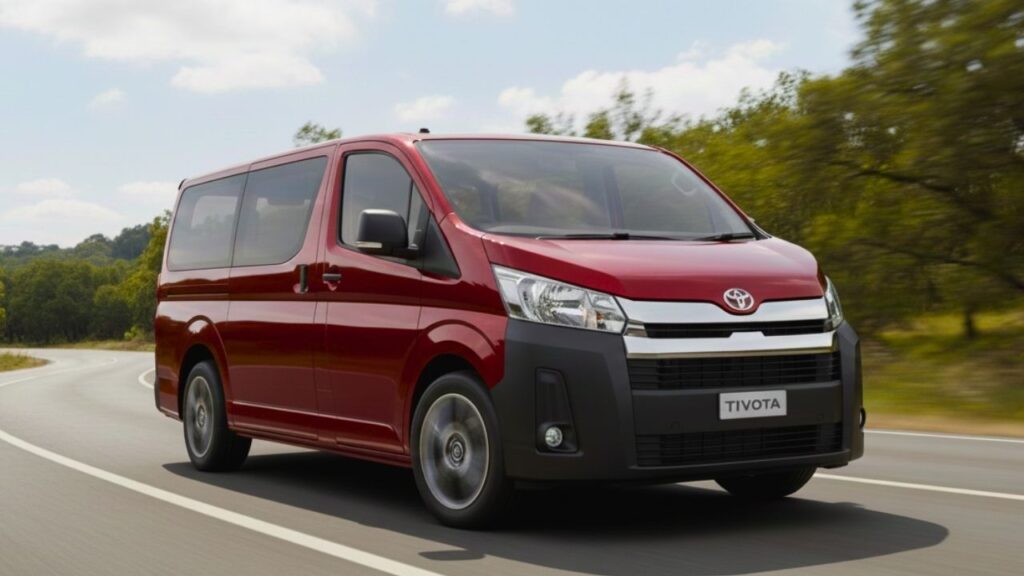
The exterior design of the 2025 Toyota HiAce is functional and purpose-built. Aerodynamic styling is secondary to visibility, access, and durability. The front end is upright and robust, allowing easy engine access for servicing while improving frontal crash protection compared to older designs.
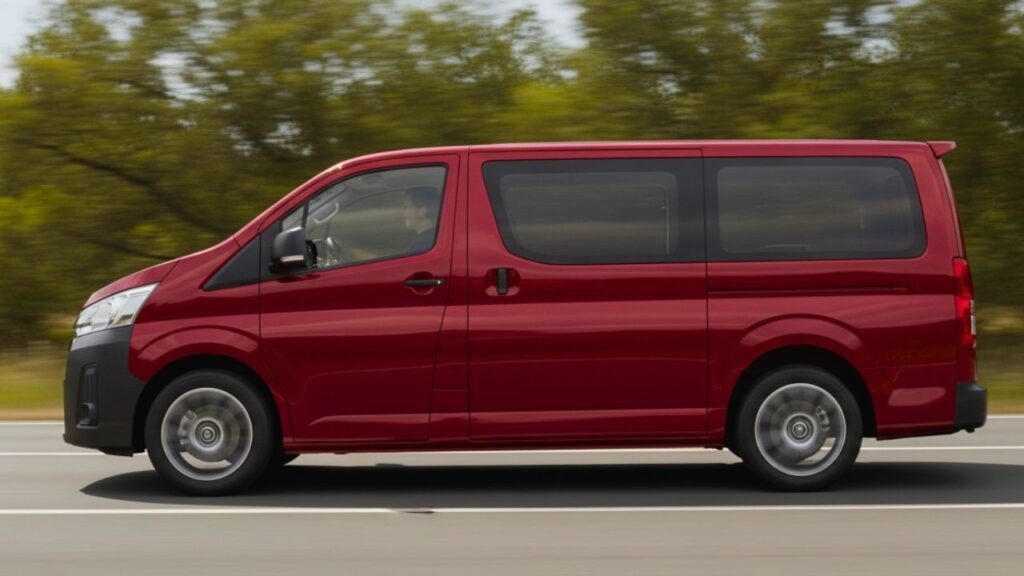
Key design priorities include wide-opening rear doors, large sliding side doors, and reinforced body panels. High-roof and long-wheelbase variants are engineered to maximize internal volume without making the vehicle difficult to maneuver in urban environments. The HiAce’s exterior may look conservative, but every element is designed to reduce downtime and withstand heavy daily use.
Interior Layout, Comfort, and Cargo Flexibility
Inside the cabin, the 2025 HiAce focuses on ergonomics and efficiency. The driver’s position is upright with excellent forward visibility, making long shifts less fatiguing. Controls are logically arranged, and materials are selected for durability rather than luxury.
Passenger configurations vary widely. Cargo vans offer a minimalist interior with durable surfaces, while commuter variants include multiple seating rows designed for shuttle and transport services. Toyota’s attention to interior layout ensures that both drivers and passengers benefit from ample headroom and practical storage spaces.
Cargo-focused models feature flat load floors, reinforced tie-down points, and wide door openings. These features simplify loading and unloading, especially for businesses that operate on tight schedules. The HiAce’s interior flexibility is one of its strongest advantages, allowing it to adapt to a wide range of industries.
Powertrain Options and Drivetrain Choices
Toyota offers the 2025 HiAce with petrol and diesel engines depending on regional requirements. There are no confirmed factory hybrid or electric versions globally for this model year, reinforcing its focus on proven internal combustion reliability.
Petrol engines are typically naturally aspirated and designed for smooth operation and low maintenance costs. These are often favored in markets where fuel quality and emissions regulations make diesel less practical.
Diesel engines remain the preferred choice for heavy-duty and long-distance use. Turbo-diesel options deliver strong low-end torque, making them ideal for hauling cargo or carrying full passenger loads. These engines are known for longevity and efficiency, especially in fleet environments.
Transmission options usually include manual and automatic gearboxes, depending on market and trim. Rear-wheel drive is standard, supporting better load handling and towing stability compared to front-wheel-drive alternatives.
Ride Quality, Handling, and Work Performance
Despite its commercial nature, the 2025 Toyota HiAce delivers stable and predictable handling. The steering is tuned for ease of use in tight urban spaces, while the suspension balances comfort with load-bearing capability.
In city environments, the HiAce benefits from a manageable turning radius and good outward visibility. These characteristics reduce driver fatigue and improve safety during frequent stops and deliveries.
On highways, the HiAce remains composed even when fully loaded. Diesel variants, in particular, offer relaxed cruising and steady power delivery, making them suitable for intercity transport and logistics operations.
Safety Features and Driver Assistance
Safety is an area where the current-generation HiAce shows meaningful improvement over older models. Standard safety features in most markets include multiple airbags, anti-lock braking systems, electronic stability control, and traction control.
Depending on region and trim, additional driver assistance features may be available. These can include lane departure alerts, rear-view cameras, parking sensors, and forward collision warning systems. Toyota integrates these technologies carefully, ensuring they enhance safety without adding unnecessary complexity.
The HiAce’s improved structural design also contributes to better crash protection, particularly for the driver and front passenger.
Technology, Infotainment, and Connectivity
Technology in the 2025 Toyota HiAce is intentionally straightforward. Infotainment systems typically include a central touchscreen with Bluetooth connectivity, USB ports, and smartphone integration where supported. The emphasis is on usability rather than entertainment.
For fleet operators, the HiAce supports telematics and diagnostic integration in certain markets. These systems help businesses track vehicle health, schedule maintenance, and optimize routes. Toyota’s approach ensures that technology supports productivity rather than distracting drivers.
Ownership Experience and Reliability Reputation
The Toyota HiAce has earned a reputation for exceptional reliability. Many examples remain in service for hundreds of thousands of kilometers with routine maintenance. This reputation is a key reason why the HiAce is often chosen over newer or more complex rivals.
Maintenance costs are generally predictable, and spare parts availability is strong in most regions where the HiAce is sold. Toyota’s global service network further enhances the ownership experience, especially for businesses operating multiple vehicles.
For buyers familiar with Toyota’s legendary durability in models like the Land Cruiser, the HiAce reflects the same engineering philosophy. This focus on toughness and longevity is comparable to the qualities highlighted in Toyota’s larger utility vehicles, such as the durability standards associated with the Toyota Land Cruiser reliability and durability lineage.
Ideal Use Cases for the 2025 Toyota HiAce
The 2025 HiAce is designed to serve a wide range of applications. Commercial operators use it for delivery services, construction support, and mobile workshops. Passenger variants are common in shuttle services, schools, and hospitality transport.
The HiAce is also a popular platform for specialized conversions. Ambulances, refrigerated vans, and camper builds frequently use the HiAce chassis due to its strength and adaptability. Toyota does not market these conversions directly, but the vehicle’s design supports extensive aftermarket customization.
2025 Toyota HiAce vs Key Global Rivals
When compared to competitors such as the Nissan Caravan, Hyundai H350, or Ford Transit in global markets, the HiAce distinguishes itself through reliability and resale value. While some rivals offer more advanced infotainment or alternative powertrains, the HiAce appeals to buyers who prioritize long-term dependability.
Toyota’s conservative engineering approach may not suit every buyer, but it aligns well with commercial users who value consistency and low operational risk.
Specifications
Technical Specifications
| Item | Details |
|---|---|
| Platform | Body-on-frame commercial van |
| Drive Type | Rear-wheel drive |
| Steering | Power-assisted rack-and-pinion |
| Suspension | Independent front, leaf spring rear |
Powertrain and Performance
| Engine Type | Output (Approx.) | Transmission |
|---|---|---|
| Petrol Naturally Aspirated | 130–160 hp | Manual / Automatic |
| Turbo Diesel | 134–174 hp | Manual / Automatic |
Fuel Economy (Global Estimates)
| Engine | Combined Fuel Use |
|---|---|
| Petrol | Approximately 9–11 km/l |
| Diesel | Approximately 11–14 km/l |
Dimensions and Weight
| Measurement | Approximate Value |
|---|---|
| Wheelbase | Short and long variants |
| Roof Height | Standard and high roof |
| Gross Vehicle Weight | Varies by configuration |
Pricing and Trims (Global Overview)
| Variant | Estimated Pricing Range |
|---|---|
| Cargo Van | Entry-level commercial pricing |
| Passenger / Commuter | Mid-range |
| Long Wheelbase / High Roof | Upper commercial tier |
Conclusion: Is the 2025 Toyota HiAce Still the Benchmark?
The 2025 Toyota HiAce remains one of the most trusted commercial vans in the world. Its appeal lies not in cutting-edge technology or luxury, but in proven reliability, adaptable design, and strong long-term value. For businesses that depend on their vehicles every day, the HiAce offers a dependable solution with minimal risk.
While it may not suit buyers seeking electrification or advanced digital features, the HiAce excels at what it is designed to do. In 2025, it continues to set the standard for durability and practicality in the global commercial van segment.
FAQ: 2025 Toyota HiAce
Is the 2025 Toyota HiAce available with a hybrid engine?
No. Toyota has not confirmed any factory hybrid or electric HiAce models globally for 2025.
What is the payload capacity of the 2025 HiAce?
Payload capacity varies by configuration, body style, and market, but it is designed to support heavy commercial use.
Is the Toyota HiAce reliable for long-term ownership?
Yes. The HiAce is widely regarded as one of the most reliable commercial vans, with strong durability and low long-term maintenance costs.
Can the 2025 HiAce be converted into a camper van?
Yes. While Toyota does not offer factory camper versions, the HiAce is commonly used for aftermarket camper conversions.
Where is the 2025 Toyota HiAce manufactured?
Production locations vary by region and market, with Toyota manufacturing the HiAce in multiple global facilities.